4 Ways GTM Teams Use Revenue Intelligence Engine to Drive Revenue
How Revenue Teams Find Growth, Validate Deals, and Catch Churn Early
By QuadSci Team
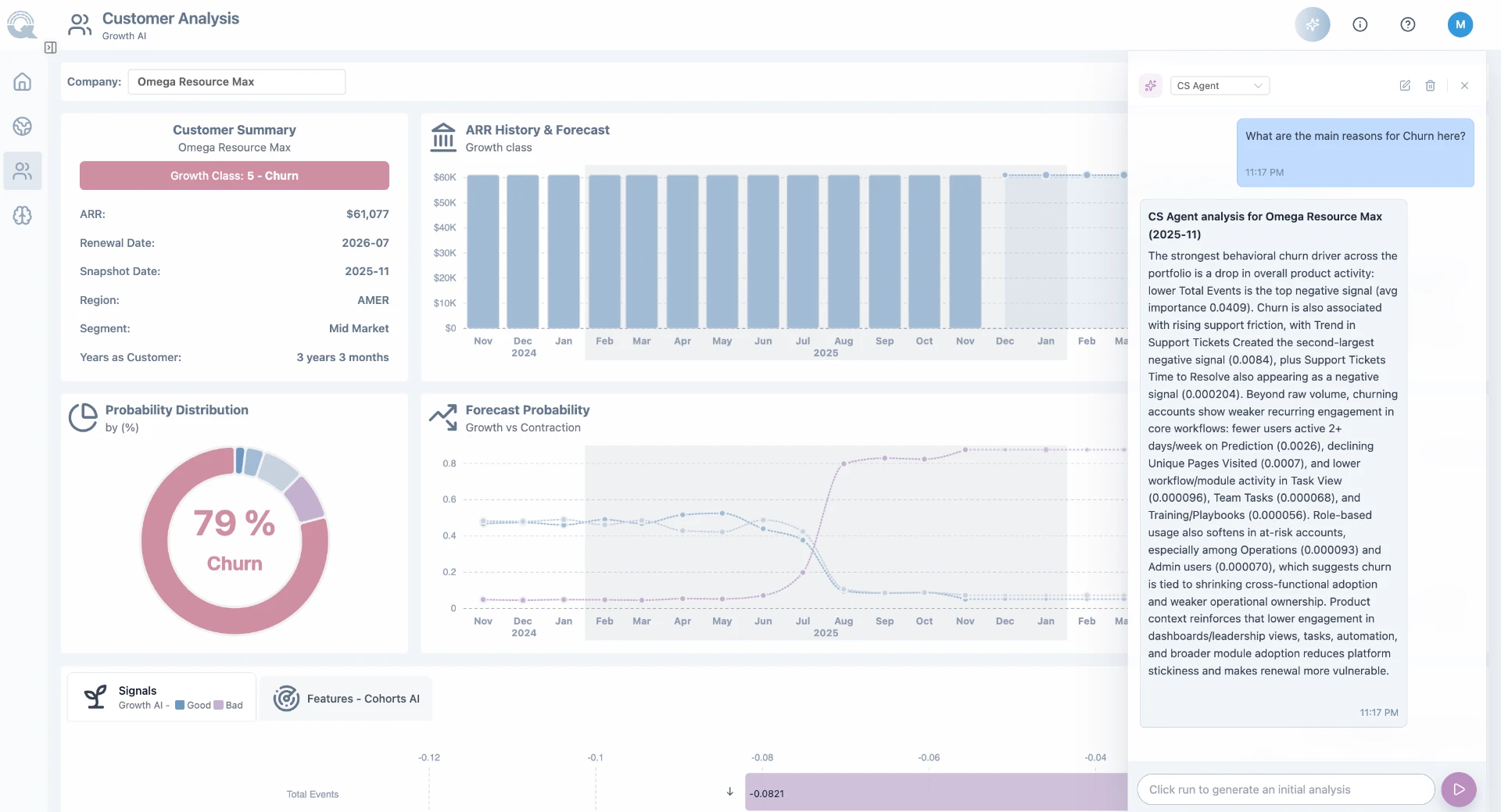
Revenue Intelligence Engine is a predictive engine built for revenue leaders. Its intelligence, delivered through detailed account and territory views along with conversational agents, turns behavior into action for every level of a revenue organization. Here are four high-level use cases that lead directly to expansion and retained revenue.
1. Find Under-Pipelined Growth Opportunities
Revenue Intelligence Engine classifies every account as High Growth, Medium Growth, Stable, Contraction, or Churn, based on real product usage rather than pipeline activity. When an account sits in High Growth or Medium Growth but shows a small deal size, limited pipeline, or no open opportunity at all, that's a gap between behavior and pipeline worth closing.
Teams use the Q-Chat Sales Agent to generate specific offering and packaging ideas for that account, turning a behavioral signal into a concrete next step. This is how QuadSci surfaces the 15% of ARR that sits unpiped on average, expansion revenue that was already visible in the data, just not yet in the forecast.
2. Validate Forecasted Deals With Behavioral Signal
For deals already sitting in the forecast, a growth classification adds an independent, evidence-based check. Revenue Intelligence Engine delivers 90% predictive accuracy for growth events, 9 to 18 months in advance, so a High Growth or Medium Growth classification is a meaningful confirmation, not a guess.
It doesn't replace a rep's judgment. It gives that judgment something concrete to stand on.
3. Catch Risk Early, While There's Still Time to Act
Revenue Intelligence Engine applies the same 90% accuracy on the churn side, surfacing Contraction and Churn signals 9 to 18 months ahead of the event, well before a renewal conversation would normally begin.
A negative classification isn't a lost cause. It's an early prompt to revalidate executive alignment, reconfirm product adoption, and reassess renewal strategy, months before the account would otherwise show up as an at-risk surprise.
4. Ground the Territory Forecast in Product Behavior
Beyond individual accounts, Revenue Intelligence Engine rolls up account-level ARR forecasts into a portfolio view inside Business Analysis. Revenue leaders use it as a cross-check against a territory or book-of-business forecast: alignment builds confidence, and a gap surfaces an assumption worth inspecting before quarter-end pressure builds.
The Common Thread
In each case, Revenue Intelligence Engine isn't replacing the judgment of sellers, CSMs, and leaders. It's giving them a source of early, objective visibility into customer behavior that pipeline and CRM data alone don't capture, so revenue teams find more of the growth that's already there and see risk with enough lead time to change the outcome.
Frequently Asked Questions
How does Revenue Intelligence Engine help find expansion revenue?
Revenue Intelligence Engine classifies every account by real product usage. Accounts flagged High Growth or Medium Growth with little or no open pipeline reveal expansion opportunities the forecast missed — on average, 15% of ARR sits unpiped in behavioral data.
How accurate is Revenue Intelligence Engine, and how far in advance does it predict?
Revenue Intelligence Engine delivers 90% predictive accuracy for both growth and churn events, 9 to 18 months in advance of the event, trained on over 15 trillion telemetry events analyzed.
Does Revenue Intelligence Engine replace a seller's or CSM's judgment?
No. Revenue Intelligence Engine adds an independent, evidence-based signal that gives human judgment something concrete to stand on, whether confirming a forecasted deal or flagging an at-risk account early enough to act.
See Revenue Intelligence Engine in action
Turn product behavior into account-level expansion and churn forecasts, 9-18 months before the event.