How Boomi Turned Product Telemetry Into 90% Churn Prediction Accuracy
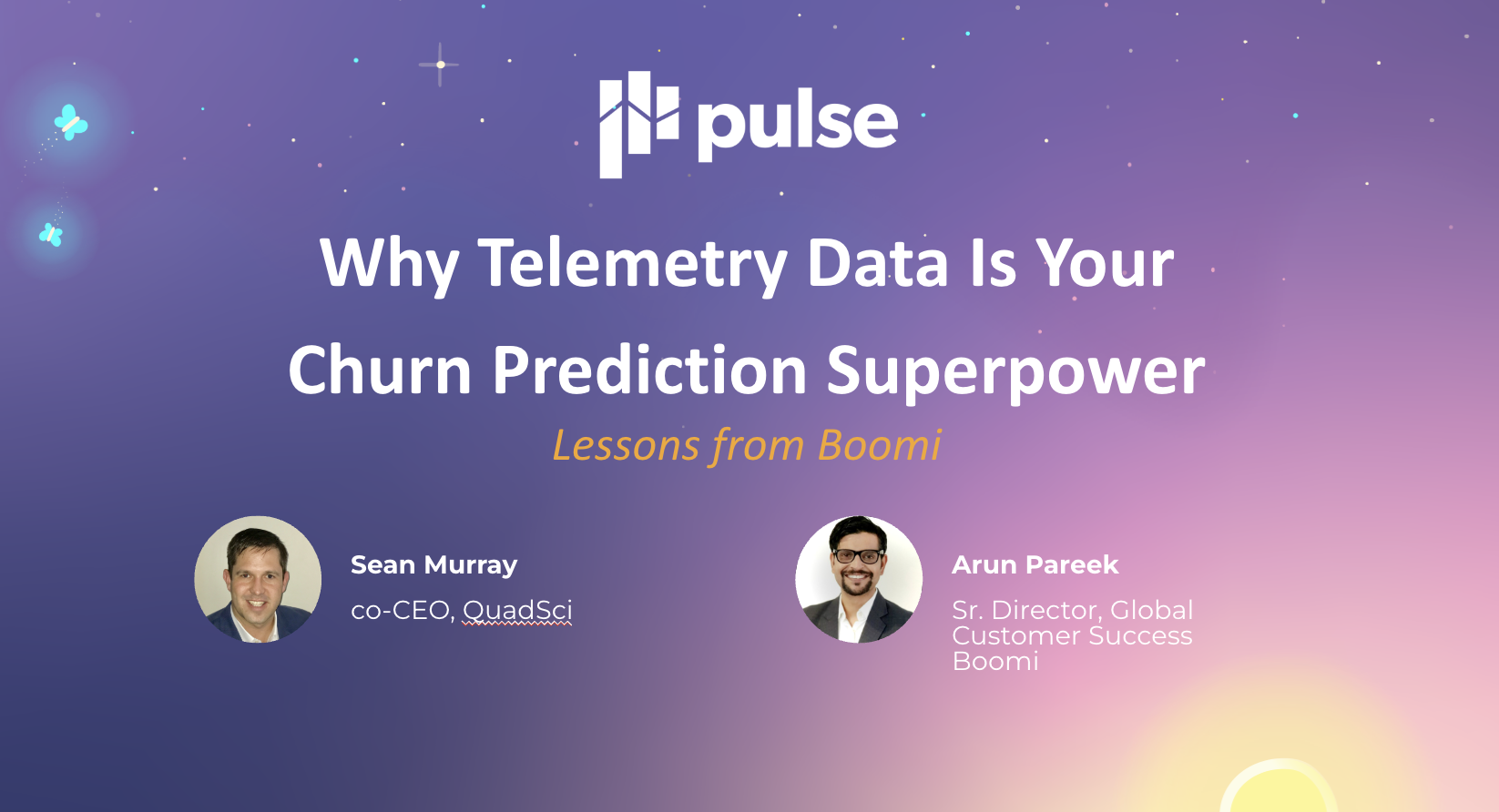
On stage at Gainsight Pulse 2026, QuadSci co-CEO Sean Murray opened the session with a question for the room: raise your hand if you've been surprised by a customer churning in the last 12 months.
Most hands went up.
"That surprise," he said, "is the problem we're going to fix today."
What followed was an in depth discussion with Arun Pareek, Senior Director of Global Customer Success at Boomi, detailing the story of how one of the most complex installed bases in enterprise software went from reacting to churn to seeing it coming a year out.
The Problem Is Not Data. It's Which Data.
Boomi has 30,000+ customers worldwide and manages 5,000+ direct accounts with a team of 100+ CSMs. They run 2,000 renewals per year, half of them complex multi-product deals, with data scattered across 10+ systems. They were not short on customer data.
What they were short on was the right data. Their prediction horizon was six months. Risk playbooks triggered too late for long-tail accounts. Surprise churn accounted for over $5M in renewal loss.
The reason is structural, and it affects nearly every CS organization. Traditional health scores capture CRM notes, support ticket volume, NPS results, and relationship signals. That is roughly 20% of the available signal. The other 80% lives inside the product: session frequency, feature adoption by role, module engagement trends, API usage patterns, workflow completion rates. It tells you what a customer actually does, not what they say in a QBR.
Boomi also had a timing problem specific to their platform. Customers who decide to leave do not do so close to renewal. Because Boomi is not a simple system to migrate off, those decisions happen 18 months out. By the time any lagging signal surfaced the risk, the decision was already made.
"Find the accounts renewing in the next 6 to 12 months and ask what their usage trend looks like over the last 90 days. That single question surfaces more risk than most health scores."
— Arun Pareek, Boomi
Building the Intelligence Layer
The solution Boomi and QuadSci built together connects Salesforce, Gong, Marketo, Gainsight, and product analytics into a unified predictive intelligence layer. QuadSci's Growth AI was trained on 70 billion Boomi telemetry events, building a custom ML model on Boomi's own historical renewal outcomes rather than a generic benchmark.
Every account is now scored as growth, contraction, or churn. Predictions surface eight months ahead of renewal. The churn prevention playbook in Gainsight activates with a 12-month head start. The full data package writes to Salesforce, predictions appear natively in Gong deal reviews, and Gainsight CTAs trigger automatically from QuadSci signals. No rep changes their workflow to see the score.
The model runs inside Boomi's own environment. No data leaves their infrastructure. At 70 billion telemetry events, that is not optional. You cannot ship data at that scale to an external vendor for processing. The model has to come to the data.
The Trust Inversion: When the Model Stopped Being the Thing You Question
Most organizations that deploy a predictive system follow the same script. Run the predictions, compare them against CSM forecasts, and when they conflict, question the system. The tool gets the benefit of the doubt last.
Boomi did the opposite. Today, when QuadSci's monthly scores conflict with a CSM forecast, the question is not "why is the model wrong?" It is "why is the human wrong?" The CSM has to make the case for their account. The model does not have to defend itself.
Boomi is no longer pressure testing QuadSci. Instead they are pressure testing the humans with the QuadSci score.
Arun was precise about why this matters. When a predictive system generates a score that conflicts with what a CSM believes, the default organizational response is to question the system. The tool becomes the problem. Teams rationalize: the data is incomplete, the model does not have the full picture, the relationship is stronger than the score suggests. Then the account churns.
At Boomi, each month QuadSci scores are stress-tested against three inputs: the CSM forecast, the manager forecast, and the legacy health score. When they diverge, that divergence is not treated as noise. It is a question the human has to answer.
The moment the switch flipped
Boomi did not decide to trust the model. The data made the decision for them. After six months of running the analysis, they had a set of accounts where CSMs had forecast no risk and QuadSci had forecast churn. Some of those accounts churned. The pattern was consistent enough that the question changed from "is the model reliable?" to "why didn't we act on it sooner?"
"The numbers have been verified. And now we have changed human behavior because this is an irrefutable piece of evidence."
— Arun Pareek, Boomi
That is a different category of trust, and it is what happens when a model has been right often enough, about the right things, that the burden of proof has moved.
What the Numbers Look Like
The FY25 results reflect both the technical accuracy and the operational change. 90% churn prediction accuracy. $27M in surprise churn surfaced across the installed base. 18% of that was mitigated through early intervention. 700%+ ROI on spend versus net dollar retention impact.
Boomi is also measuring a 10% improvement in forecast accuracy on renewals six months out. That is not just a CS metric. It is a CFO metric. Revenue predictability at the account level, compounding across 2,000 renewals a year, changes how a finance team models the business and how a CRO plans headcount.
The 700%+ ROI, from the inside
That number is not a calculation in a spreadsheet. It is a CSM team that no longer spends meetings defending a health score. It is a manager who already knows which accounts to push on before the call starts. It is a surprise churn that became a saved renewal because someone acted on the signal twelve months before the renewal date.
What Boomi Told the Pulse Audience To Do On Monday
Arun closed with two actions he said any CS leader could take immediately, regardless of whether they have a predictive intelligence platform in place.
First: identify where telemetry already exists. Product event data likely lives in Gainsight PX or a product analytics tool. The raw material is probably there. It just has not been connected to revenue.
Second: map usage to the renewal calendar. Find the accounts renewing in the next six to twelve months and look at their usage trend over the last 90 days. That single question surfaces more risk than most health scores.
Those two steps describe the beginning of what Boomi and QuadSci built together: a line between product behavior and commercial outcome. Once that line exists, and once the team has seen it be right enough times, the question stops being whether to trust it. The question becomes how much time you lost before you did.
The Principle Underneath The Results
Sixty-five percent of software companies have flat or declining NRR since 2023. Seventy-seven percent of CEOs cite retention as their number one growth lever. And yet 84% report high customer satisfaction. The gap between satisfaction and retention is the 80% of signal that traditional health scores never see.
Telemetry is truth. It tells you what customers do, not what they say. When you build your intelligence layer on that foundation, twelve months of lead time is not a product feature. It is what becomes possible when the signal finally matches the stakes. And when the model has been right often enough, something more important happens: you stop defending it, and you start expecting everyone else to keep up.