Cohorts AI vs Growth AI: What's the Difference and Why You Need Both
By QuadSci Team
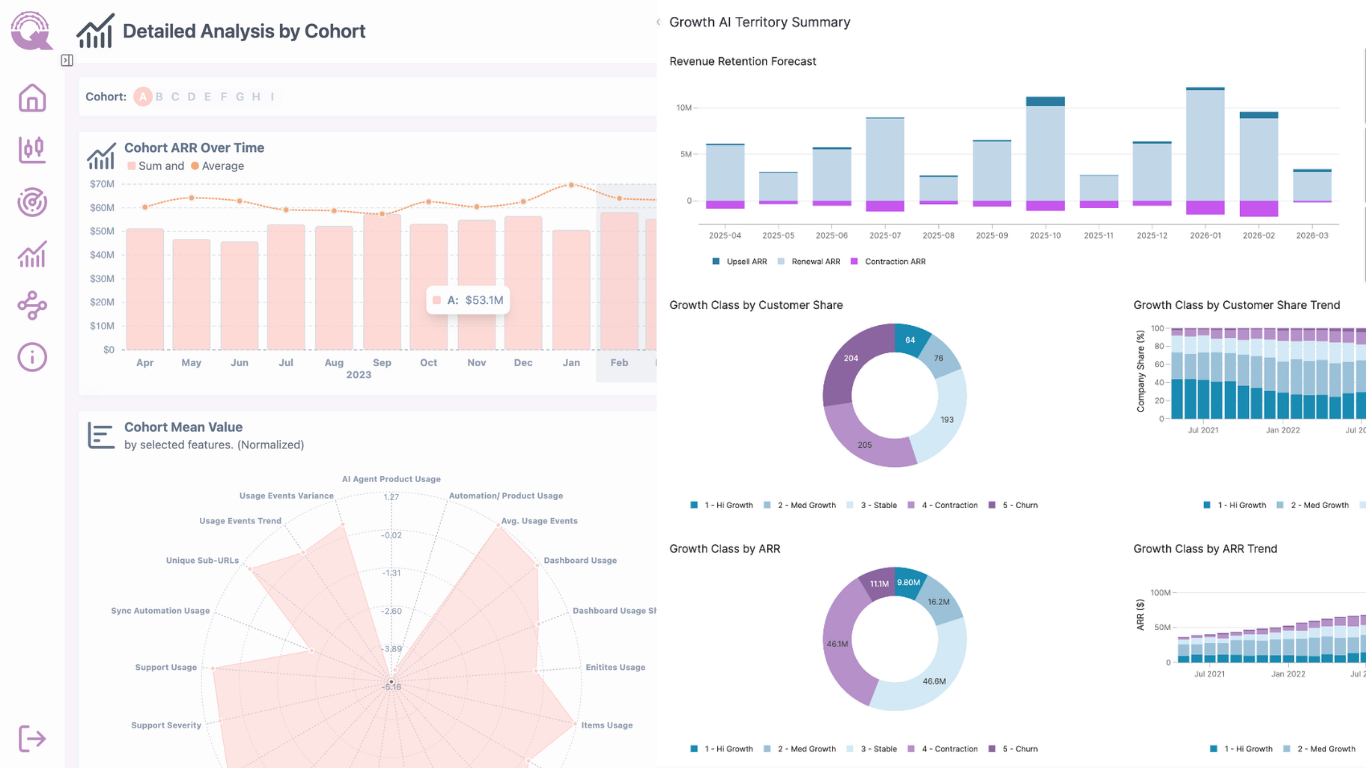
Most revenue teams are trying to answer two fundamental questions: What are our customers doing? And what will that mean for our business?
Different teams use different pieces of software to try and answer those questions. Product analytics tools show how customers use features, while revenue systems track pipeline, renewals, and expansion. The two systems don't speak to each other and the picture that emerges is siloed and incomplete.
Cohorts AI and Growth AI address this gap from two different directions.
Understanding Customer Behavior: Cohorts AI
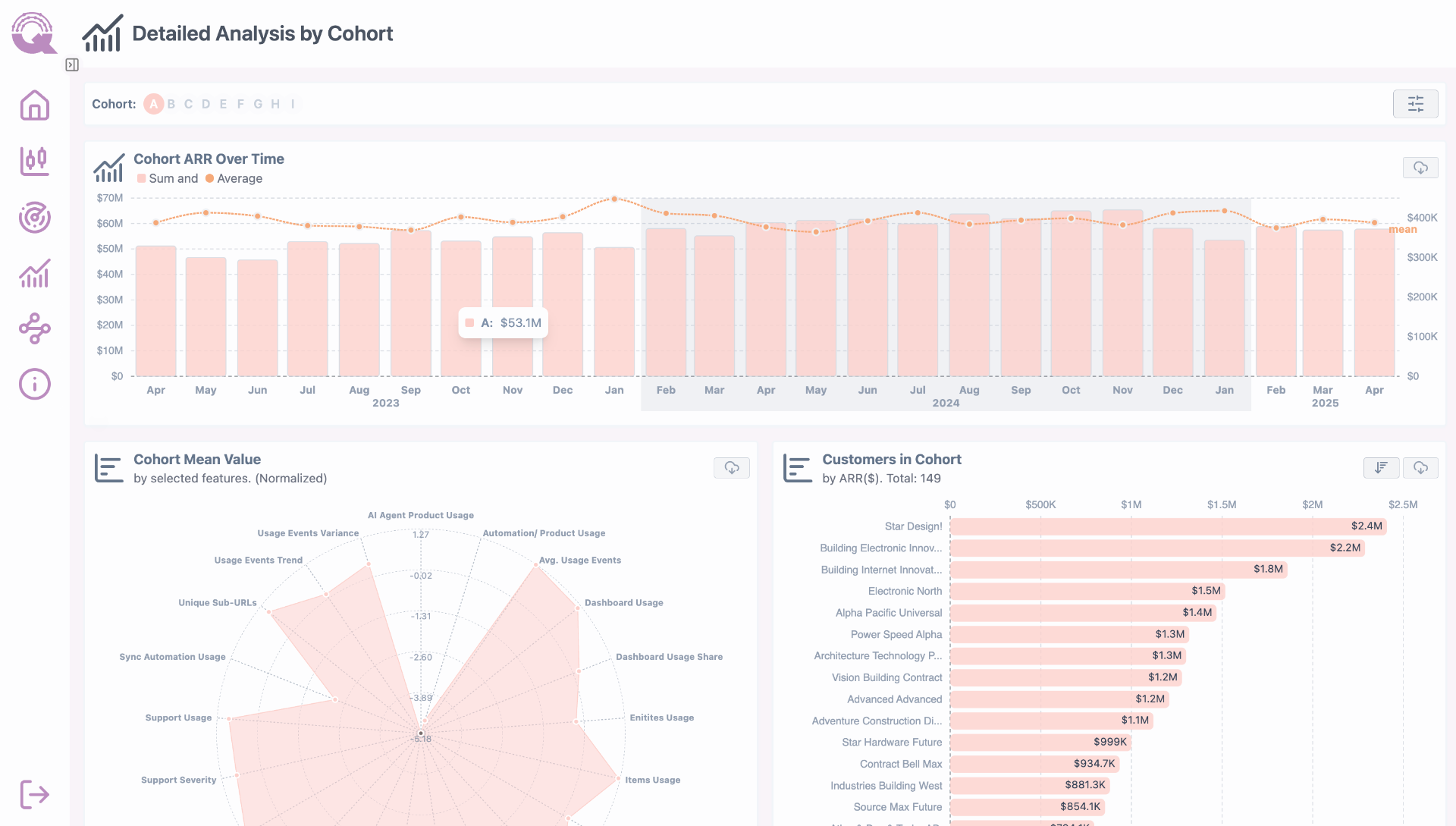
Cohorts AI focuses on how customers use a product by uncovering the full range of behavioral patterns that exist across a customer base.
Instead of segmenting customers by industry, company size, or persona, it analyzes product telemetry to identify how customers actually interact with the product over time. These patterns are not predefined. They emerge directly from usage, capturing the different ways customers adopt, expand, specialize, or disengage.
The result is a set of usage-based cohorts directly tied to ARR and business outcomes. This creates a unified view of the customer base, where patterns of usage are continuously mapped to value, rather than interpreted in isolation.
Some customers demonstrate broad, mature adoption across multiple features, embedding the product deeply into their workflows. Others are still building foundational usage, engaging with only a subset of capabilities. There are also customers whose usage is highly specialized, as well as those whose activity remains limited or inconsistent. What matters is not the label assigned to each cohort, but the clarity these patterns provide when viewed together.
Taken as a whole, this creates a continuous and comprehensive view of the customer base alongside ARR performance, making it possible to see not just how customers behave, but how that behavior correlates to revenue.
From this foundation, the AI reveals:
- The full range of engagement patterns across the customer base, from high and sustained usage to more limited or inconsistent activity.
- The features and behaviors that consistently drive value, as well as those that signal emerging risk
- The specific usage patterns that define high-performing customers and the ARR outcomes associated with them
This moves Cohorts AI beyond segmentation into a system for understanding and shaping behavior. By making these patterns visible, teams can identify where customers are today and design targeted interventions to move them toward higher-value usage states.
Cohorts AI answers a foundational question: how are customers actually using the product, and how does that usage translate into value?
Understanding Revenue Trajectory: Growth AI
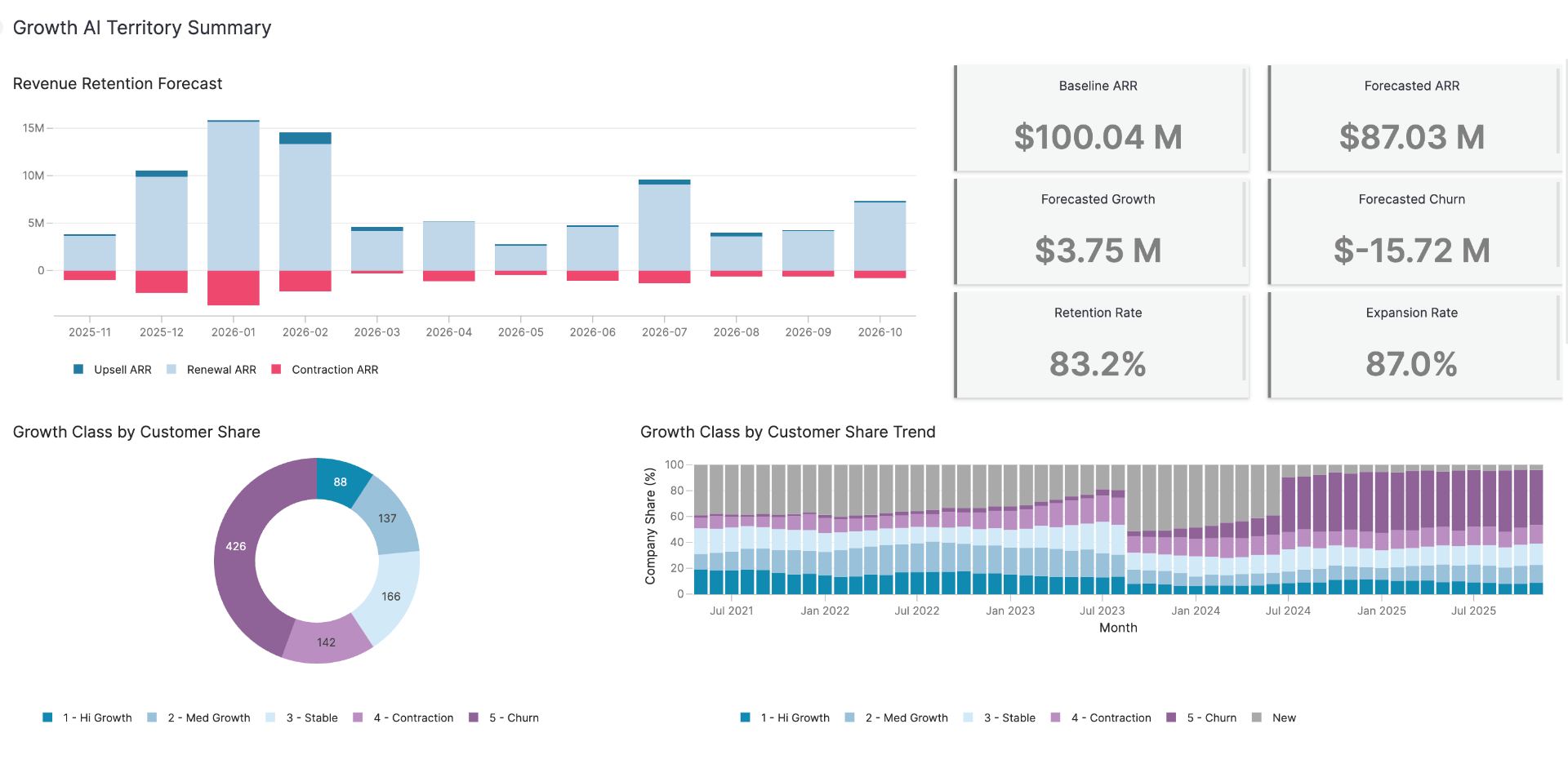
Growth AI focuses on where revenue is headed by connecting how customers behave to how revenue actually forms. It analyzes product usage, customer engagement, support patterns, and commercial data together, creating a clear picture of each account that reflects not just its current state, but its trajectory over time. Rather than relying on static health scores or pipeline indicators, the system evaluates how behavioral patterns have historically translated into expansion, stability, or churn across the broader customer base.
Each account is then classified into one of five outcome categories based on that trajectory:
- High growth (150%+ NDR), where behavior reflects strong and expanding value realization
- Moderate growth (110% to 150% NDR), where usage supports incremental expansion
- Stability (>95% to 110% NDR), where adoption is sufficient to sustain the relationship but not deepen it
- Contraction (>0% to 95%), where behavioral signals indicate declining value
- Churn, where patterns align with full disengagement
This classification is not a snapshot. It reflects how the account is evolving relative to patterns observed across similar customers, which allows the model to surface change earlier than traditional indicators.
Alongside classification, Growth AI produces forward-looking ARR forecasts at both the account and aggregate level, giving leadership a more precise view of how revenue is likely to move over the next several quarters. These forecasts are supported by customer-specific signals drawn from usage, engagement, and operational trends, making it possible to understand not just what is likely to happen, but why.
Over time, the system also surfaces macro-level insights, identifying the behavioral patterns that consistently drive growth or precede churn across the entire customer base. This creates a feedback loop between individual account strategy and broader GTM decision-making.
Taken together, Growth AI moves beyond prediction as a standalone output. It provides a structured view of where revenue is forming, where it is at risk, and what signals are shaping those outcomes, allowing teams to engage earlier and with far more precision.
Growth AI answers a simple but historically difficult question: what will happen next, and what should we do about it?
From Insight to Coordination
When both systems operate together, they create a shared intelligence layer across teams that helps to align action and decision making. Marketing can target accounts based on adoption maturity and growth potential. Sales can prioritize expansion where behavior supports it. Customer success can intervene earlier with a clear understanding of both risk and cause, and product teams can see which features drive movement across cohorts and revenue outcomes.
Instead of working from separate views of the customer from separate pieces of software, teams operate from a common foundation. What emerges is a new operating model grounded in customer behavior relative to ARR value that uses historical data to predict future revenue movement.
See Both Products in Action
Discover how Cohorts AI and Growth AI work together to give your GTM teams a unified view of customer behavior and revenue trajectory.